

Labscapes: Expanding the Optical Field of Elkhorn Slough
Visualizing Coastal Resilience through Art, Science, and Immersive Storytelling
Proposal for the Illuminating Climate Futures RFP for
National Geographic.
A framework for Elkhorn Slough 2026–2028.
Labscapes: Expanding the Optical Field of Elkhorn Slough is a contemporary visual storytelling proposal centered on the coastal wetlands research of and the broader climate resilience initiatives supported by the Paytan Lab, CCCR, & Nat Geo. The project explores how evolving optical technologies can deepen and extend the environmental archive of Elkhorn Slough through expanded fields of view that move between microscopic, human, aerial, and spatial scales of observation. Nature-based solutions are increasingly recognized as critical tools in addressing climate resilience and ecological restoration.
Designed and proposed by Saul Villegas of Moderno, the project combines photography, macro imaging, moving image, drone cinematography, panoramic compositions, 360 video, and immersive spatial scans to create a contemporary optical profile of one of California’s most dynamic estuarine ecosystems. Rather than replacing earlier environmental documentation, the project builds upon the legacy of historical archives by introducing new modes of perception and imaging that reflect the evolving relationship between technology, ecology, and climate research.
Functioning as a multimedia proof-of-concept, the proposal highlights the Coastal Wetlands research conducted through the Paytan Lab while documenting the scientists, technicians, landscapes, and environmental systems working toward climate resilience and wetland restoration. Through expanded optical fields, layered aspect ratios, and immersive environmental storytelling, the project positions Elkhorn Slough as both a living ecological archive and a contemporary site of interdisciplinary research, public engagement, and environmental stewardship.

Project Overview
This project documents coastal wetlands as living climate infrastructure. Through collaboration with researchers connected to the Center for Coastal Climate Resilience and UC Santa Cruz, the work translates scientific research into an accessible visual experience for public audiences.
Focusing on Adina Paytan’s lab and field research at Elkhorn Slough, this preview page serves as a proof-of-concept for a larger multimedia story about nature-based solutions, wetland restoration, and climate resilience.
My approach combines documentary photography, cinematic video, 360 media, and experimental image-making to translate scientific research into a public-facing visual experience. Rather than simply documenting the field site, the work creates a layered environmental portrait where research, landscape, and perception become interconnected.
This project extends my ongoing practice of creating visual dioramas—constructed spaces of observation that use photographic and moving-image techniques to make complex systems feel intimate, atmospheric, and accessible.
Why This Story Matters

Wetlands are more than landscapes. They are protective ecological systems that absorb carbon, support biodiversity, filter water, and help buffer coastlines from flooding and sea-level rise.
As climate change reshapes coastal environments, wetland restoration offers a powerful model for nature-based solutions. This project uses visual storytelling to help audiences see the hidden labor, research, and ecological relationships behind coastal resilience.
Featured Research: Adina Paytan Research Lab

Dr. Adina Paytan’s research investigates coastal and marine systems, with attention to how environmental change affects water quality, nutrient cycles, and ecosystem health. This project focuses on the lab’s wetland-related research as a way to visualize how science contributes to climate adaptation and restoration.


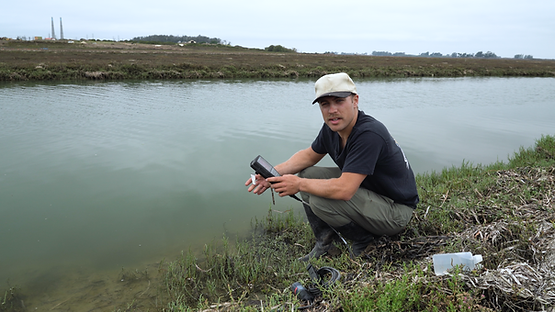

Elkhorn Slough as a Living Archive
Elkhorn Slough becomes both a research site and a visual archive. Through tides, mudflats, marsh grasses, birds, water channels, and field observations, the landscape reveals how climate research is embedded in place.
This section presents the wetland not only as a scientific field site, but as an environment of memory, transformation, and ecological attention.
Elkhorn Slough becomes both a research site and a visual archive. Through tides, mudflats, marsh grasses, birds, water channels, and field observations, the landscape reveals how climate research is embedded in place.


Inside the Paytan Lab

Located within the Earth & Marine Sciences facilities at the University of California, Santa Cruz, the Paytan Lab serves as a central analytical space where water, sediment, and environmental samples collected from Elkhorn Slough are processed and studied to better understand coastal change and wetland carbon dynamics. The laboratory bridges field observation with scientific analysis, transforming samples gathered from marshes, tidal channels, and restoration sites into data that informs research on nature-based climate solutions. Through imagery of instrumentation, sample preparation, technicians at work, and environmental materials under observation, this profile highlights the often-unseen laboratory processes that connect the estuary to broader questions of climate resilience, carbon sequestration, and ecological stewardship.


Video Profile
This short video introduces Paytan's research, the landscape, and the people working to understand coastal change. Combining field documentation, interview audio, and environmental imagery, the video functions as an early sample of the larger story.
Public Impact
The goal of this project is to make climate research visible, emotionally accessible, and publicly engaging. By combining scientific collaboration with immersive media, the project invites audiences to better understand how wetlands contribute to climate resilience and why restoration matters.
This proof-of-concept demonstrates how the final project could grow into a multimedia feature, public exhibition, educational resource, or digital story platform.


